
Marine Biomedical: First Half 2026 Company Update
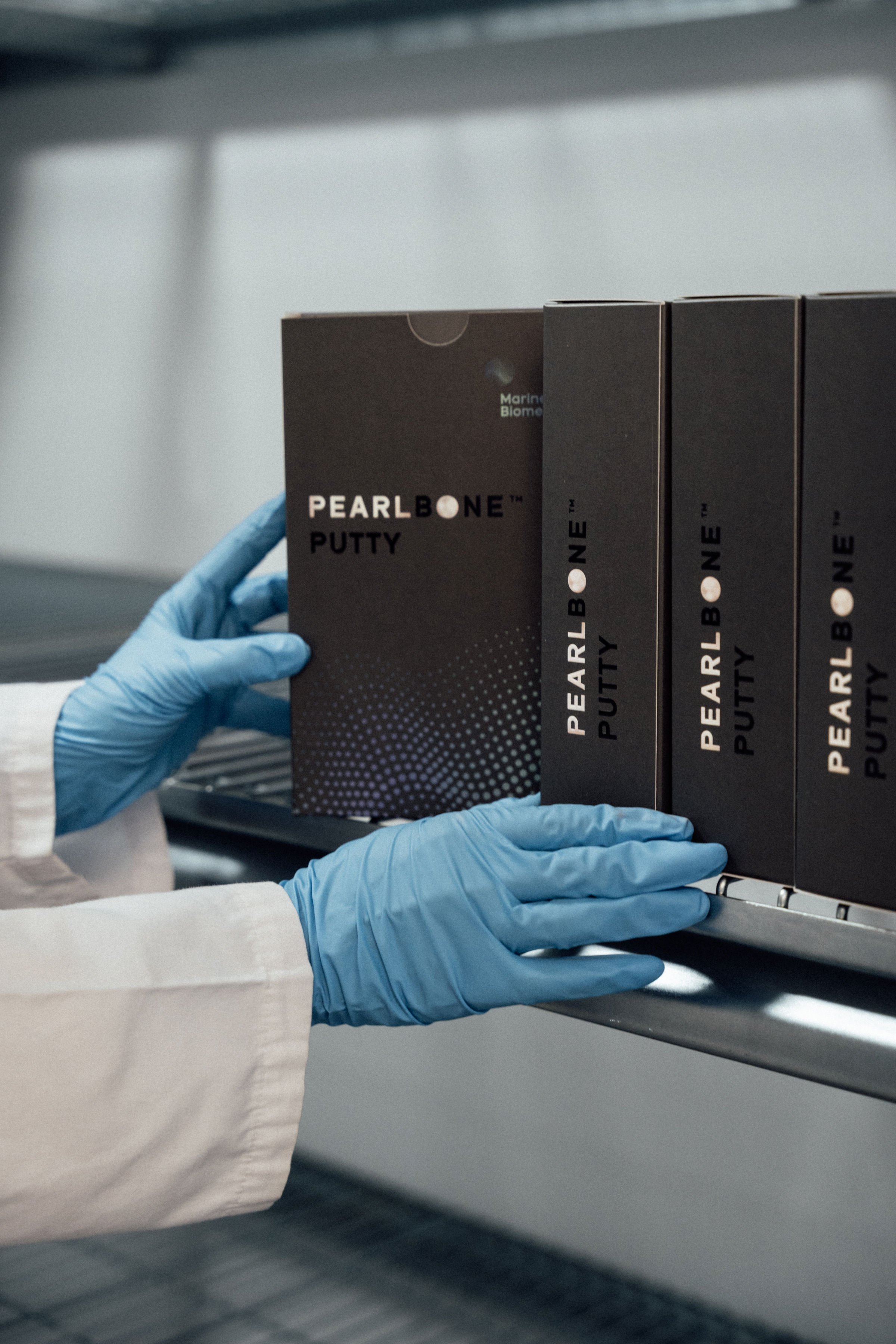
The first half of 2026 has marked an important period of progress for Marine Biomedical as we continue advancing PearlBone™ toward regulatory approval, commercialisation and international market entry.
Across regulatory development, strategic investment, scientific engagement and industry representation, Marine Biomedical has continued to strengthen the foundations required to translate its marine-derived biomaterials platform into meaningful clinical applications.
Advancing PearlBone™ through the US regulatory pathway
A major milestone during the first half of the year was the submission of Marine Biomedical’s 510(k) application to the United States Food and Drug Administration for PearlBone™.
The submission represents the culmination of years of disciplined scientific development, regulatory preparation and manufacturing execution by the Marine Biomedical team and its collaborators.
PearlBone™ is a next-generation, marine-derived bone graft substitute developed from sustainably sourced pearl shell. The material is designed to support bone regeneration and is manufactured at Marine Biomedical’s purpose-built facility in Broome, Western Australia, under internationally recognised quality standards.
The 510(k) submission is a significant step in the company’s pathway toward potential entry into the United States orthopaedic market. It also reflects the broader opportunity for advanced, sustainably derived biomaterials across orthopaedic reconstruction, trauma, spinal fusion and other procedures requiring bone graft substitutes.
PearlBone™ is the first product developed from Marine Biomedical’s broader marine biomaterials platform, creating a foundation for future regenerative medicine applications.
Strengthening the pathway to commercialisation
Marine Biomedical also announced a strategic investment and commercial arrangement with Australian regenerative medicine company Orthocell.
Under the agreement, Orthocell made a $1 million strategic investment in Marine Biomedical and secured a first right of refusal to commercialise Marine Biomedical’s bone repair and regeneration products on a product- and territory-specific basis.
The investment builds on Marine Biomedical’s $2.1 million capital raise completed in May 2025 and strengthens the company’s commercialisation pathway as PearlBone™ progresses through regulatory review and market-readiness activities.
The agreement represents valuable strategic validation of the PearlBone™ technology, its scientific foundations and its potential application across orthopaedic, trauma and reconstructive surgery.
It also supports Marine Biomedical’s ambition to build a globally relevant regenerative medicine company with advanced manufacturing capability based in Western Australia.
Increasing global awareness of PearlBone™
During the first half of 2026, Marine Biomedical expanded its presence across several leading biotechnology and medical technology forums, using these opportunities to increase awareness of PearlBone™ and strengthen the company’s international profile.
CEO Rolee Kumar presented at AusMedtech 2026 in Perth, where Marine Biomedical participated in discussions focused on Western Australian innovation, investment and the growth of Australia’s medical technology sector. The event provided an important platform to introduce PearlBone™ to clinicians, investors, industry leaders and potential commercial partners.
Rolee also represented Marine Biomedical at LSI Asia 2026 in Singapore, presenting the company’s technology, regulatory progress and commercial vision to an international audience of medtech executives, investors and strategic partners.
At the BioInnovation Festival, Rolee presented “From Broome to the FDA: PearlBone™ and the First Ticket to Market,” outlining the company’s journey from regional scientific innovation to engagement with the United States regulatory pathway.
Together, these appearances reflect growing recognition of Marine Biomedical as an emerging Australian biotechnology company with globally relevant technology. They have also created valuable opportunities to build relationships, gather market insights and communicate the potential of PearlBone™ across the international orthopaedic and regenerative medicine sectors.
As PearlBone™ progresses through regulatory review, this increased visibility will support Marine Biomedical’s efforts to develop clinical, investment and commercial partnerships in key markets.
Recognising scientific leadership
In January, Marine Biomedical was proud to congratulate founder and medical and scientific adviser Professor Minghao Zheng on being appointed a Member of the Order of Australia.
Professor Zheng received the honour in recognition of his contribution to orthopaedic research, regenerative medicine and biomedical innovation.
Internationally recognised for his leadership in bone and neurological science, biomaterials and translational research, Professor Zheng has played a significant role in advancing matrix scaffold technologies from laboratory discovery toward clinical application.
His scientific insight, clinical perspective and strategic guidance continue to support the development of PearlBone™ and Marine Biomedical’s broader regenerative medicine platform.
This recognition reflects not only Professor Zheng’s individual contribution to medical science, but also the depth of expertise underpinning Marine Biomedical’s work.
Deepening clinical and scientific engagement
Marine Biomedical has continued to engage with leading clinicians, researchers and international experts as it prepares PearlBone™ for future clinical and commercial use.
Recent scientific discussions with Professor Stuart Goodman of Stanford University provided an opportunity to review PearlBone™ preclinical data and histological results supporting evidence of advanced and rapid bone formation in a critical bone defect model.
These discussions also explored potential clinical applications, future commercialisation pathways and longer-term planning for human clinical trials.
Engagement with experienced international clinicians remains an important part of Marine Biomedical’s development strategy. It provides valuable external perspectives on product performance, clinical utility and the requirements for future adoption in real-world surgical settings.
The company remains focused on building a strong evidence base around PearlBone™, supported by rigorous preclinical research, specialist clinical input and a clearly defined regulatory pathway.
Building a globally relevant company from Western Australia
Marine Biomedical’s progress during the first half of 2026 demonstrates the potential for sophisticated biotechnology and medical device development to be undertaken in regional Australia.
From its manufacturing facility in Broome, the company is combining marine science, biomaterials engineering, clinical research, quality systems and sustainable sourcing to create new approaches to bone repair and regeneration.
The PearlBone™ story is also an example of circular innovation. A material originating from the Western Australian pearling industry is being transformed into a high-value biomedical product with potential applications in global healthcare.
This model creates opportunities beyond a single product. It supports advanced manufacturing, scientific employment, regional capability development and the creation of Australian-owned intellectual property with international commercial potential.
Looking ahead
As Marine Biomedical enters the second half of 2026, the company’s priorities remain focused on supporting the FDA review process, progressing commercial-readiness activities and strengthening relationships with clinical, regulatory and strategic partners.
The team will also continue developing the evidence, manufacturing capability and market infrastructure required to support the future introduction of PearlBone™.
The progress achieved so far reflects the contribution of Marine Biomedical’s employees, founders, researchers, advisers, investors, government partners and industry collaborators.
Together, they are helping build a new Australian biomaterials company with the potential to improve bone healing and contribute to the future of regenerative medicine.